
Kontakt
Znajdź nas:
Twój schowek
(0)
0 szt.(0,00 )
Zaloguj się
Aparatura kontrolno-pomiarowa. 
Dystrybucja, serwis, kalibracja

Symulator kanału otwartego 86×300 mm

Dodaj do zapytania

Kod producenta: (HI101)

Opis produktu – Symulator kanału otwartego 86×300 mm

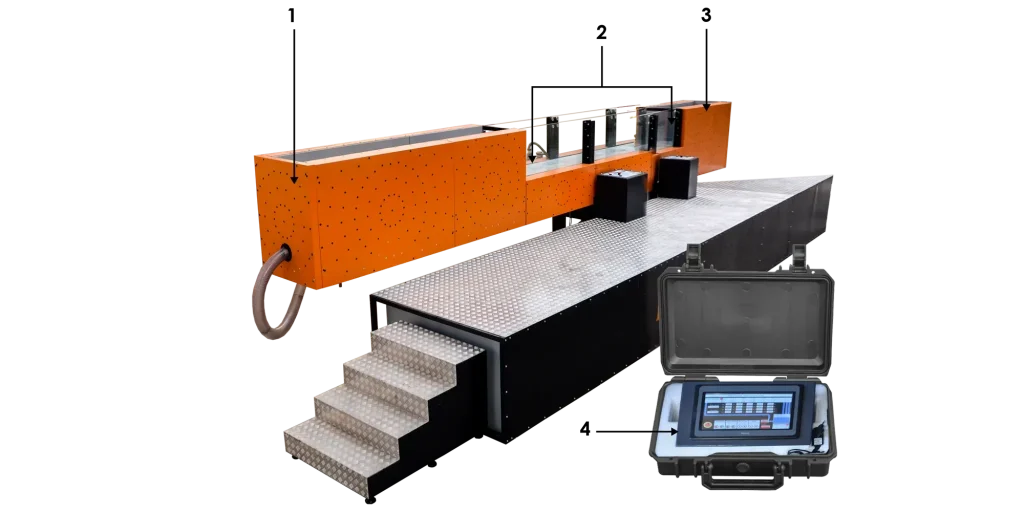
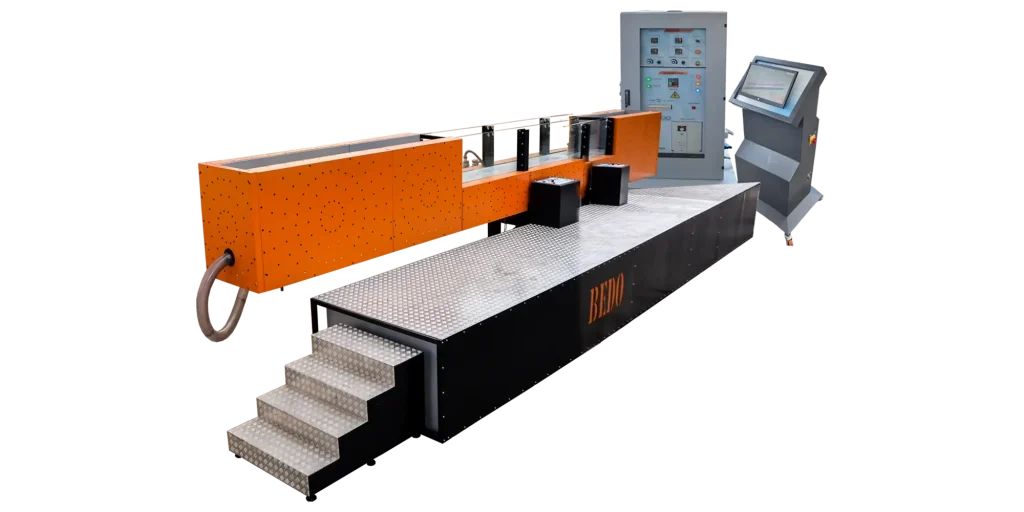
Symulator kanału otwartego (HI101) został zaprojektowany w celu zilustrowania zasad mechaniki płynów w zastosowaniu do przepływu w kanale otwartym. Ściany boczne sekcji eksperymentalnej są wykonane z hartowanego szkła, aby zapewnić całkowitą widoczność przepływu i eksperymentów.

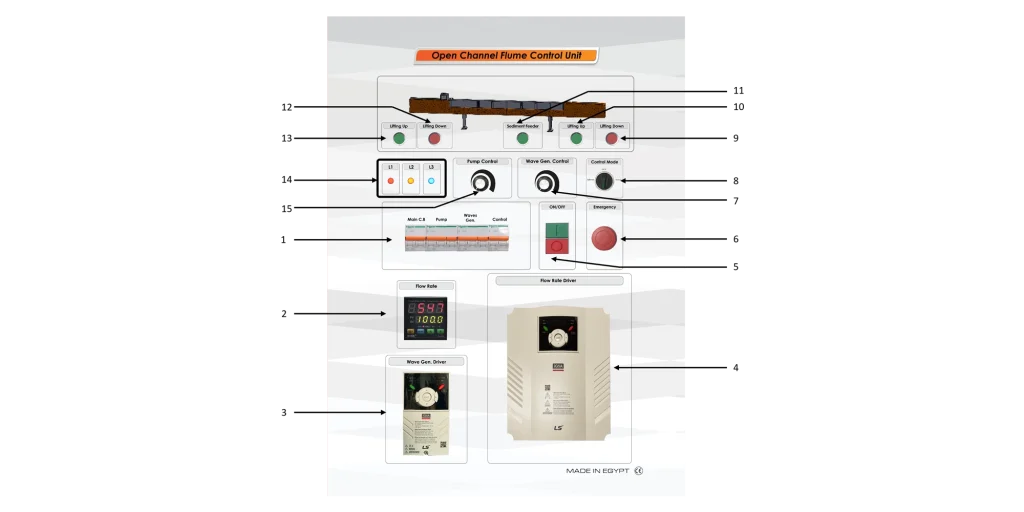
1. Wyłączniki 2. Natężenie przepływu 3. Sterownik generatora fal 4. Sterownik natężenia przepływu 5. Włącznik/wyłącznik sterowania 6. Wyłącznik awaryjny. 7. Sterowanie prędkością generatora fal 8. Tryb sterowania 9. Podnośniki w dół 10. Podnośniki w górę 11. Podajnik osadów 12. Podnośniki w dół 13. Podnośniki w górę 14. Diody LED wskazujące działanie jednostki sterującej 15. Pokrętło regulacji prędkości pompy


Dane techniczne

  • Sekcja doświadczalna
    • Długość: 2,5 m i przekrój 86×300 mm i może być zmodyfikowana do długości 6 min na życzenie klienta.
    • Regulacja nachylenia: -0,5 do 3%
    • Zbiornik: 280 L
    • Przepływ: 0-15 L/min
  • Pompa
    • Maks. przepływ: 15m3/h
    • Maks. wysokość podnoszenia: 21m
  • Zakresy pomiarowe
    • Przepływ: 0…10m3/h

Zakres dostawy

  • Symulator otwartego kanału 86×300 mm (HI101)
  • Twarda instrukcja obsługi

Opcje

  • Struktury kontrolne (HI101. 01)
    • Brama śluzowa (HI101.01.01)
    • Brama promieniowa (HI101.01.02)
    • Zestaw jazów płytowych, cztery typy (HI101.01. 03)
    • Jazar z szerokim grzbietem (HI101.01.04)
    • Jazar zgniatający (HI101.01.05)
    • Jazar syfonowy (HI101.01.06)
    • Jazar z grzbietem dębowym z ciśnieniem (HI101.01.07)
    • Jazar z grzbietem dębowym z dwoma wylotami jazu (HI101. 01.08)
    • Elementy rozpraszania energii (HI101.01.09)
  • Zmiana konstrukcji przekroju poprzecznego (HI101.02)
    • Dno koryta z kamieniami żwirowymi (HI101.02. 01)
    • Parapet (HI101.02.02)
    • Przepust (HI101.02.03)
    • Zestaw słupów, siedem profili (HI101.02.04)
  • Przepływy pomiarowe (HI101.03)
    • Przepust Venturia (HI101.03. 01)
  • Inne eksperymenty (HI101.04)
    • Wibrujące pale (HI101.04.01)
    • Generator fal (HI101.04.02)
    • Plażowa plaża (HI101.04.03)
    • Nośnik instrumentów (HI101.04. 04)
  • Przyrządy pomiarowe (HI101.05)
    • Poziomomierz (HI101.05.01)
    • Dziesięć manometrów rurowych (HI101.05.02)
    • Czujnik przepływu z licznikiem cyfrowym (HI101.05. 02)
    • Elektroniczny pomiar ciśnienia, 10x 0…50 mbar (HI101.05.04)
  • Oprogramowanie (HI101.06)
    • System akwizycji danych i automatyzacji (HI101.06.01)
    • Moduł zdalnego sterowania (HI101. 06.02)
    • Urządzenie PC (HI101.06.03)
  • Zawartość cyfrowa (BI01)

Szczegóły techniczne

  • Jednostka edukacyjna zawiera rynnę eksperymentalną z sekcją eksperymentalną, elementem wlotowym i wylotowym oraz zamkniętym obiegiem wody.
  • Element wlotowy zawiera układ nieruchomy, który rozprasza przepływ wody przed wejściem do kanału, zapewniając płynny, jednolity przepływ.
  • Poziom w sekcji eksperymentalnej jest kontrolowany za pomocą jazu przelewowego na końcu wylotowym.
  • Jednostka edukacyjna zawiera również zbiornik na wodę, pompę i ręczną regulację przepływu.
  • Nachylenie sekcji eksperymentalnej można dokładnie regulować za pomocą podnośnika.
  • Długość sekcji eksperymentalnej wynosi 2,5 m i może być przedłużona do 5 m.
  • Ściany boczne sekcji eksperymentalnej są wykonane z hartowanego szkła, aby zapewnić całkowitą widoczność przepływu i eksperymentów.
  • Wszystkie powierzchnie jednostki edukacyjnej, które mają kontakt z wodą, są wykonane ze stali nierdzewnej.
  • Element wlotowy jest zaprojektowany tak, aby przepływ wpływał do sekcji eksperymentalnej z bardzo małymi turbulencjami.
  • Szeroki wybór modeli (niedołączonych do zestawu), takich jak jazy, pomosty, rynny do pomiaru przepływu lub generator fal są dostępne jako akcesoria i zapewniają kompleksowe zrozumienie eksperymentów
  • Jednostka edukacyjna jest zamontowana na sztywnej ramie.

Experiments

  • Study of open channel flow.
  • How to apply force-momentum and steady flow energy equations to simple flow situations
  • Uniform and non-uniform discharge.
  • Derivation of the flow formula.
  • Study of the flow transition (hydraulic jump).
  • Study of energy dissipation (hydraulic jump, stilling basin)
  • Calculation of the energy dissipation (hydraulic jump, stilling basin).
  • Measuring the flow rate in flumes.
  • Calculating the local losses due to obstacles.
  • Study of the transient flow (waves).
  • Study of vibrating piles
  • Study of sediment transport

Optional Accessories

Sluice Gate (HI101.01.01)

  • This module is used to study the flow under a sluice gate.
  • Specifications
    • The gate opening of the sluice gate and therefore the discharge under the gate can be manually adjusted with a handwheel.
    • The sluice gate has lateral sealing lips.
    • It also includes a scale to read the height of the gate opening.
  • Experiments
    • Free discharge under a sluice gate.
    • Submerged discharge under a sluice gate.
    • Observation of jet contraction.
    • Observation of downstream hydraulic jumps.
  • Technical Data
    • Head adjustment: 0…150mm
    • width: 80 mm.

Radial Gate (HI101.01.02)

  • This module is used to study the flow under a radial gate.
  • Specifications
    • Height of the gate can be adjusted using a lever.
    • The radial gate has lateral sealing lips.
  • Experiments
    • Free discharge under a radial gate.
    • Submerged discharge under a radial gate.
    • Observation of jet contraction.
    • Observation of downstream hydraulic jumps.
  • Technical Data
    • Width: 80mm
    • Radius of the segment: 298mm

Set of Plate Weirs, Four types (HI101.01.03)

  • This module is used to study the flow over sharp-crested weirs.
  • Specifications
    • The module includes 3 sharp-crested weirs for the experimental flume.
    • It includes a rectangular weir with optional aeration as sharp-crested weir.
    • The weir height is identical for all weirs.
    • The plate weir to be studied is inserted in a frame.
    • The transparent frame with lateral sealing lips is mounted in the flume.
    • The weirs are made of stainless steel.
  • Experiments
    • Free and submerged over-fall at the sharp-crested weir
    • Effect of aeration on flow processes at plate weirs
    • Together with a level gauge:
      • Plate weirs as measuring weirs: determination of the discharge coefficient; comparison of the measuring weirs
    • Determination of the discharge
    • Comparison of the theoretical and the measured discharge
  • Technical Data
    • Thomson weir: triangular weir opening
    • Rehbock weir: rectangular weir opening
    • Cipoletti weir: trapezoidal weir opening

Broad-Crested Weir (HI101.01.04)

  • This module is used to study the flow over broad-crested weirs.
  • Specifications
    • The weir has sharp edges.
    • The module includes 2 additional elements for rounded edges.
    • The weir body is hollow with sealing lips.
  • Experiments
    • Free and submerged over-fall at the broad-crested weir.
    • Effect of the weir edges on flow processes.
    • Sharp-edged contour.
    • Rounded contour.
    • Together with a level gauge
    • Determination of the discharge coefficient.
    • Determination of the discharge.
    • Comparison of the theoretical and the measured discharge.

Crump Weir (HI101.01.05)

  • This module is a weir according to E.S. Crump.
  • Specifications
    • The weir body contour is designed according to E.S. Crump.
    • The weir body includes sealing lips.
  • Experiments
    • Free and submerged over-fall at the Crump weir
    • Observation of downstream hydraulics jumps
    • Discharge at a sill
    • Together with a level gauge:
    • Determination of the discharge
    • Comparison of the theoretical and the measured discharge
  • Technical Data
    • Weir body
      • Inclination (upstream): 1:2
      • Inclination (downstream): 1:5

Siphon Weir (HI101.01.06)

  • This module represents a siphon weir with optional venting.
  • Specifications
    • It is a siphon weir used for the experimental flume.
    • The weir body is made of PMMA.
    • The module includes a valve for venting the siphon weir.
    • The weir body is with sealing lips.
  • Experiments
    • The functioning of a siphon weir.
    • The flow rate of a siphon weir.
    • Comparison of pipe flow and free over-fall in a siphon weir.
  • Technical Data
    • Material: PMMA
    • Discharge flow cross-section W×H: 72 x 35 mm

Ogee-Crested Weir with Pressure Measurement (HI101.01.07)

  • This module is used to study the pressure distribution along the downstream side of an ogee-crested weir.
  • Specifications
    • It is considered a weir crest with chute.
    • The module includes eight pressure measuring points in the downstream side of the weir.
    • Manometer tubes are integrated.
    • The weir body is with sealing lips.
  • Experiments
    • Hydrodynamic over-fall at the ogee-crested weir.
    • Pressure distribution along the downstream side of the weir for different discharges.
    • Together with a water level and a velocity meter:
      • Determination of discharge and head
      • Comparison of the theoretical and the measured discharge
  • Technical Data
    • Manometer tubes measuring range: 480mmWC

Ogee-Crested Weir with Two Weir Outlets (HI101.01.08)

  • This module is used to study the flow over ogee-crested weirs.
  • Specifications
  • The ogee-crested weir is used for the experimental flume.
  • The module includes two different weir outlets: chute and chute with ski jump.
  • The weir body is with sealing lips.
  • Experiments
  • Effect of the weir outlet on flow processes in case of chute and chute with ski jump.
  • Position of hydraulic jump depending on downstream water level
  • Together with a water level and a velocity meter:
  • Determination of the sequent depth.
  • Determination of discharge and head.
    • Comparison of the theoretical and the measured discharge.
  • Technical Data
    • Weir with chute: L×W×H: 172x86x160 mm
    • Weir with chute with ski jump: L×W×H: 210×84×160mm

Elements for Energy Dissipation (HI101.01.09)

  • This module is used to study the energy dissipation downstream of an ogee-crested weir.
  • Specifications
    • The elements for energy dissipation are used for the experimental flume.
    • It is used as an accessory for the Ogee-crested weir with two weir outlets module.
    • The elements include one chute block, two baffle blocks with five rectangular blocks, one baffle block with five triangular blocks, and two end sills with different height.
    • The base plate contains evenly spaced threaded holes.
  • Experiments
    • Comparison of the effect of different elements for energy dissipation such as: chute blocks, baffle blocks and end sills.
    • Observation of the hydraulic jump with and without end sills respectively baffle blocks.
  • Technical Data
    • Chute block: L×W×H: 172×84×160mm
    • End sill
      • L×W×H: 84x25x25mm
      • L×W×H: 84x25x50mm
    • Baffle blocks
      • L×W×H: 84x25x25mm
      • blocks, W×H: 14x14mm
    • Base plate

Flume Bottom with Pebble Stones (HI101.02.01)

  • This module is used to study the fundamentals of open channel flow.
  • Specifications
    • The flume roughness is changed using this flume bottom.
    • The flume bottom contains pebble stones consisting of two elements.
  • Experiments
    • Fundamentals of open channel flow: uniform and non-uniform discharge.
    • Effect of flume bottom roughness on flow behavior.
    • Flow formulae.
  • Technical Data
    • L×W×H: 2500×84×60mm (1 element)

Sill (HI101.02.02)

  • This module is used to study the reduction of the flow cross-section in a flume.
  • Specifications
    • The sill is used for the main experimental flume.
    • The sill has sealing lips.
    • The module includes removable assembly aids.
  • Experiments
    • Behavior of open channel flow at a reduction of flow cross-section.
  • Technical Data
    • Inclination of inlet/outlet element: approx. 15°

Culvert (HI101.02.03)

  • This module is used to study the full flow through culvert and partially filled culvert.
  • Specifications
    • The culvert is used for the experimental flume.
    • The channel body is transparent and made from PMMA.
    • The channel body is hollow, fitted with a rectangular and a circular cross-section.
    • The module includes 2 covers to close the unused cross section.
    • The channel body has sealing lips.
    • The module also contains clamping device for mounting the culvert into the experimental flume.
  • Experiments
    • Behavior of open channel flow at reduced flow cross-sections.
    • Free and submerged culvert inlet.
    • Culvert outlet with free or submerged discharge
    • Different shapes of culvert cross-section
    • Rectangular cross-section
    • Circular cross-section
  • Technical Data
    • Culvert cross-sections
    • Circular, inner diameter: 44mm
    • Rectangular, W×H: 39×39mm

Set of Piers, Seven Profiles (HI101.02.04)

  • This module is used to study the lateral reduction of cross-section in the flume.
  • Specifications
    • The piers are used with the experimental flume
    • These piers cause little or considerable reduction of cross-section caused by piers
    • The pier profiles include rectangular, circular, square, rounded on one end, rounded on both ends, tapering profile on one end and tapering profile on both ends
    • There is a pier holder with clamping device for the mounting of piers into the experimental flume.
    • Up to three piers can be mounted at the same time on nine different positions
    • The pier holder contains angle scale to indicate the angle of attack.
  • Experiments
    • Subcritical discharge with little or considerable reduction of cross-section.
    • Supercritical discharge with little or considerable reduction of cross-section.
    • Effect of the pier profile.
    • Backwater upstream of piers.
    • Flow transition at the pier.
    • Effect of angle of attack.
  • Technical Data
    • Piers made of PVC
    • Angle scale: ±90°

Venturia Flume (HI101.03.01)

  • This module represents a typical flow- measuring flume.
  • Specifications
    • The venturi flume is used for the experimental flume.
    • The venturi flume consists of one base plate, two side elements, and one clamping device.
    • The side elements have sealing lips.
  • Experiments
    • Discharge measurement in open channels.
  • Technical Data
    • Venturi flume
    • L×W×H: 450×84×260mm
    • Narrowest cross-section, W×H: 42×240 mm

Vibrating Piles (HI101.04.01)

  • This module is used to study the vibrations of a single pile or of two parallel piles in a flow.
  • Specifications
    • The rods are used as vibrating piles for the experimental flume.
    • The module contains three single rods with different diameters.
    • The module includes a weight holder with weights as additional masses for the single rod to be studied.
    • Vibration of 2 parallel piles can be achieved by 2 identical rods with holding device and the distance of rods is adjustable.
    • When a single rod is studied, the holding device for parallel piles is fastened on the flume bottom.
  • Experiments
    • Vibration of a single pile.
    • Observation of a Karman vortex street
    • Effect of the rod diameter
    • Effect of additional masses
    • Coupled vibrations between two piles.
  • Technical Data
    • Single rods: length 300mm, Diameters = 4mm, 6mm and 8mm

Wave Generator (HI101.04.02)

  • This module is used for the generation of surface waves
  • Specifications
    • The wave generator is used for the experimental flume.
    • The generation of surface waves is done by a paddle swinging back and forth.
    • The drive of the paddle is through a crank mechanism and motor with gear.
    • The crank mechanism stroke is adjustable.
    • The motor has variable speed though a frequency converter.
  • Experiments
    • Observation of waves: different wave shapes
    • Study the absorption and reflection of wave forces at different beaches. by using the set of beaches module.
    • study the behavior of waves at piers by using the set of piers.
  • Technical Data
    • Motor
      • Power output: ¼ HP
      • Speed: 1375min-1
      • Output speed: 0…110min-1

Plain Beach (HI101.04.03)

  • In combination with the wave generator, the plain beach is used to study the wave run-up at different beaches.
  • Specifications
    • The simulation of differently ascending beaches can be done by adjusting the inclination of the beach body.
    • All components are made of corrosion resistant materials.
  • Experiments
    • With the wave generator:
      • Wave run-up at an impermeable plain beach.
      • Wave run-up at an impermeable rough beach.
      • Wave run-up at a beach with permeable surface.
      • Effect of beach inclination.
      • Effect of depth of water.
  • Technical Data
    • Beach surface, L×W: 410×82mm

Level Gauge (HI101.05.01)

  • The module represents an accessory for measuring water levels.
  • Specifications
    • It is a device used for measuring discharge depths in the experimental flume.
    • It is used together with the instrument carrier module.
    • The measurement is done either with probe tip or hook.
    • It consists of a vertically travelling probe tip or hook.
    • It also includes a scale to indicate the discharge depth.
    • All components are made of corrosion resistant materials.
  • Experiments
    • Study the discharge depth for many experiments in open channel flow.
  • Technical Data
    • Scale measuring range: 0…300mm
    • Max. travel: 300mm

Ten Tube Manometers (HI101.05.02)

  • This module is used to display up to ten discharge depths along the experimental section simultaneously.
  • Specifications
  • The holding device of the manometer is mounted directly at the experimental section of the experimental flume.
  • The holding device is fitted with screws and spirit level to compensate for the inclination of the experimental section.
  • The connection between the measuring points of the experimental section and tube manometers is done by a set of hoses.
  • Technical Data
  • Measuring ranges: 0 – 510 mmWC, graduation: 1mm

Flow Sensor with Digital Counter (HI101.05.03)

  • This module is used to display up to ten discharge depths along the experimental section simultaneously.
  • The wide dynamic flow range of 0.3 to 6 m/s (1 to 20 ft/s) allows the sensor to measure liquid flow rates in full pipes and can be used in low pressure systems.
  • The Model 515 sensors are offered in a variety of materials for a wide range of pipe sizes and insertion configurations.
  • Specifications
    • General
    • Operating Range :
      • 0.3 to 6 m/s
      • 1 to 20 ft/s
    • Pipe Size Range :
      • DN15 to DN900
      • ½ to 36 in.
    • Linearity :
      • ±1% of max. range @ 25 °C (77 °F)
    • Repeatability :
      • ±0.5% of max. range @ 25 °C (77 °F)

Electronic Pressure Measurement, 4x 0…50 mbar (HI101.05.04)

  • It is used to display up to ten pressure heads simultaneously along the experimental section of the experimental flume in software.
  • Specifications
    • The pressure sensors are connected to the measuring points of the experimental section.
    • The module includes a measuring amplifier with inputs for the flow rate sensor of the experimental flume and the pressure sensors.
    • The maximum distance between PC and switch box should be about 6m.
    • There is a storage system to save the components.
  • Technical Data
    • Pressure: 4x 0 – 50mbar, corresponds to 0 – 500mmWC
    • Flow rate: 1x 0…15m3/h

System for Data Acquisition and Automation (HI101.06.01)

  • This system represents the automated operation and data acquisition of the experimental flume.
  • Specifications
    • The system offers the automated operation and data acquisition of the experimental flume.
    • The adjustment of electrical inclination and displacement sensor are mounted on height adjustable support of experimental flume.
    • The maximum distance between PC and switch box should be about 6m.
    • The electrical connection of inclination adjustment is done with switch box of the experimental flume.

Remote Control Module (HI101.06.02)

  • The remote control module is a handheld device which contain a HMI screen, where we can use it to control all of the system parameters remotly.
  • Specifications
    • With the remote control module user have full access to control all the system parameters such as:
      • Wave generator operation and speed.
      • Pump operation and speed.
      • Control lifting jacks positions.
    • Also with the remote control module user can read all of the system parameters such as:
      • Wave generator speed.
      • Pump speed.
      • water tank level.
      • water speed.
      • System flow rate.
    • The remote control module also give user the ability to calibrate the pressure sensor to get an accurate reading for the water level in the channel.
    • The remote control module also have an emergeny button which can cut the power to the whole system in case of any danger happened.
    • The remote control module comes in a hard plastic case to store it in case of no use, also it contain a charger to recharge the controller in case of the battery level is decreased.

PC Unit (HI101.06.03)

  • Specifications
    • A PC unit is mounted on a movable base
    • The PC unit can be connected to the control panel
    • Core I7, 8 G Ram
    • Screen : 19 Inch
Zapytaj o produkt
Nasi sprzedawcy pomogą Państwu dobrać odpowiednią aparaturę.

    Formularz kontaktowy

    Profesjonalna aparatura

    Serwis i kalibracja

    Prezentacje

    Leasing i raty

    Solidny partner

    Ostatnio oglądałeś
    • Miernik wielofunkcyjny Sonel MPI-530 z wyposażeniem standardowym i certyfikatem kalibracji! Przy zakupie miernika otrzymasz rabat na ponowne wzorcowanie miernika w laboratorium Merazet S.A. Miernik wielofunkcyjny najnowszej generacji pozwalający na wykonanie wszystkich…
      Sonel
    • Oscyloskop cyfrowy GDS-1072A-U 2x70MHz 1GSa/s, pamięć 2M – rejestrator Parametry które wyróżniają oscyloskopy serii GDS100A-U od konkurencji: pamięć 2M – Technologia MemoryPrime *. funkcja GO/NoGO funkcja Data Logger – rejestrator…
      GW Instek
    • GPT-9804 – Tester Bezpieczeństwa Elektrycznego 4-w-1 (AC/DC/IR/GB, 200 VA)   GPT-9804 to najbardziej rozbudowany model serii GPT-9800, łączący w jednym urządzeniu cztery kluczowe testy bezpieczeństwa: Hipot AC, Hipot DC, pomiar…
      GW Instek
    • Przenośny oscyloskop HandScope 2x20MHZ OX5022-CK Wysokiej jakości przenośny cyfrowy oscyloskop z izolowanymi kanałami 600V KAT III,  o paśmie 20 MHz. Funkcje i parametry 19 automatycznych pomiarów, 2 niezależne multimetry, rejestracja…
      Metrix
    • Analizator jakości energii elektrycznej C.A 8335 Chauvin Arnoux Analizator CA 8335 to idealne rozwiązanie do obserwacji, monitorowania oraz rejestracji zdarzeń oraz parametrów jakości energii elektrycznej. Został zaprojektowany aby ułatwić i…
      Chauvin Arnoux
    • Komory klimatyczne Binder MKF z kontrolą temperatury (-40°C do 180°C) i wilgotnością Komory do symulacji warunków środowiskowych serii MKF marki BINDER nadają się idealnie do wszelkich testów zimna i ciepła,…
      Binder
    • Mierniki grubości powłok PosiTector 6000, DeFelsko Positector 6000 to solidny, dokładny i prosty w obsłudze miernik wykorzystujący zjawisko indukcji magnetycznej i prądów wirowych. Służy do pomiaru grubości powłok na podłożach ferromagnetycznych…
      Defelsko
    • Mikroskopy odwrócone serii AE2000 Cena dla modelu AE2000 Binocular (halogen 30W) Mikroskop odwrócony AE2000 został stworzony z myślą o rutynowej obserwacji hodowli komórkowych. Najnowsza seria obiektywów z systemu CCIS® gwarantuje…
      Motic

    Zarejestruj miernik kupiony w Merazet i odbierz 10% zniżki na wzorcowanie!

    Rejestruje miernik
    Może Cię zainteresować

    Inne kategorie z grupy Zestawy edukacyjne – stoły elektrotechniczne

    Zaufali nam

    Zaufali nam klienci instytucjonalni, firmy przemysłowe, laboratoria, oraz klienci indywidualni. Między innymi firmy

    Masz pytania?

    48 61 8644 600
    poczta@merazet.pl

    Każdy produkt w ofercie posiada dedykowanego opiekuna handlowego.
    Wybierz producenta albo model produktu i znajdź sprzedawcę: