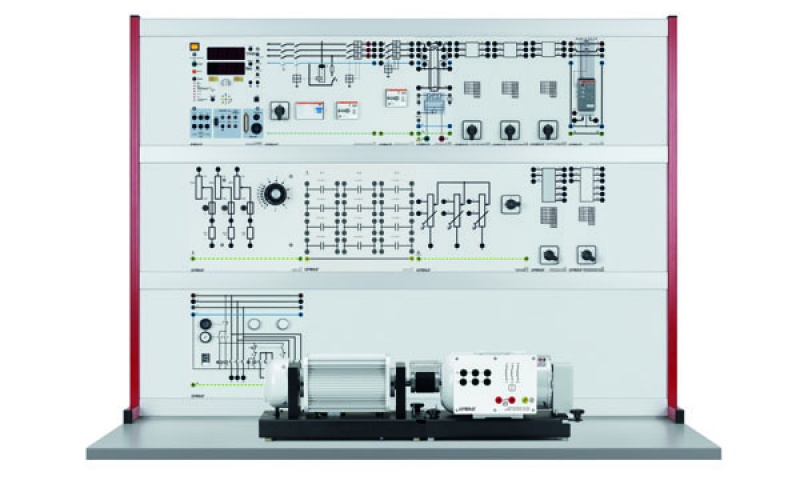
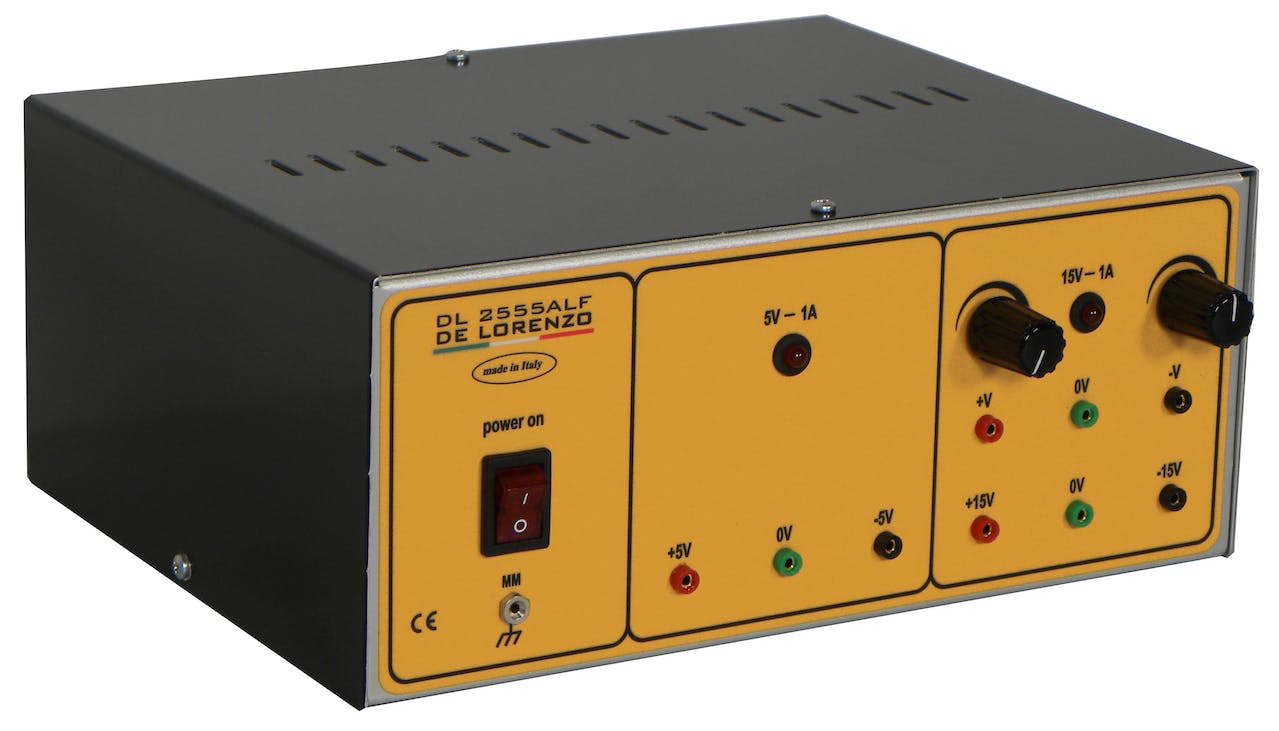
The experiments are carried out using machines of industrial manufacture. All the test machines are equipped with a special base for attachment to the Machine test system 0.3. The system allows the characteristics of the machines under test to be recorded. Power for the machines under test is provided either directly from the mains or via special laboratory power supplies.
Objectives
-
Protective measures and electrical safety
-
Setting up electrical machines and putting them into operation
-
Use of starting circuits
-
Assessment of electrical machine characteristics
Induction or asynchronous machines are in widespread use. In particular, the low-maintenance squirrel cage motors fed via frequency converters are increasingly replacing both DC and AC machines. Asynchronous machines are used as motors and generators for low power applications of up to 2.5 MW. When used as generators in wind turbines, asynchronous generators operate without additional auxiliary energy.
Basic Drive
-
Squirrel cage motors in the Basic Drive class are industrial machines which are supplied with the manufacturers' original terminal board. An illustration of the winding configuration has been deliberately omitted.
-
The safety sockets on the terminal board are safely accessible behind a plexiglass pane.
-
The winding terminals are labelled according to international standards.
-
Basic Drive machines are supplied with no temperature sensors and need to be protected from overloading by means of a motor protection circuit breaker. The experiments are therefore very similar to industrial practice.
-
Basic Drive machines are available exclusively in the 300 W rating class.
The individual equipment set is equally suitable for student experiments in laboratories with low voltage supplies (400 V three-phase) and for setting up on a mobile trolley for demonstration by teachers in a classroom. The procedures for the experiments are provided in a printed manual.
The target group is made up of commercial apprentices and students of electrical machine construction. The course offers experiments at an intermediate level and also allows for the necessary insight into machine behaviour for scientific interpretation at undergraduate level.
Topics
-
Design and function
-
Characteristics during motor operation
-
Starting
-
Star-delta starting
-
Stator resistance starting circuit
-
Braking
-
Power performance of an ideal rotating field machine
-
Power flux
-
Locus (Heyland circle) diagram
-
Open-circuit experiment
-
Short-circuit load experiment
Similar to illustration