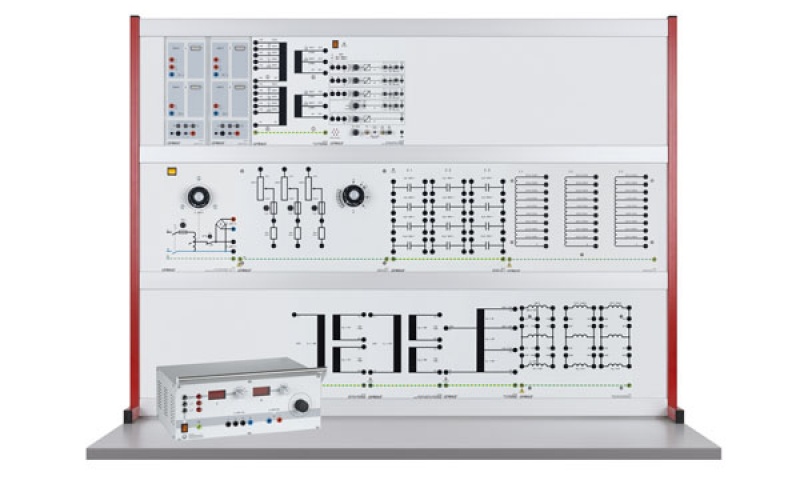
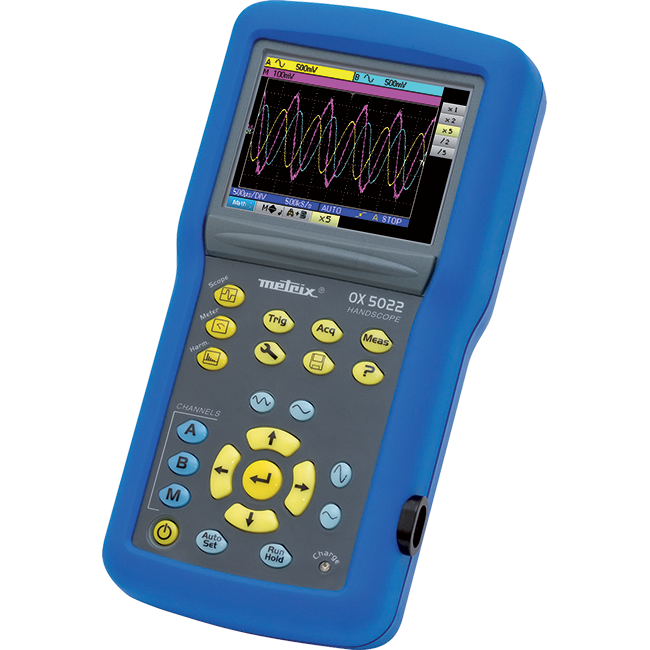
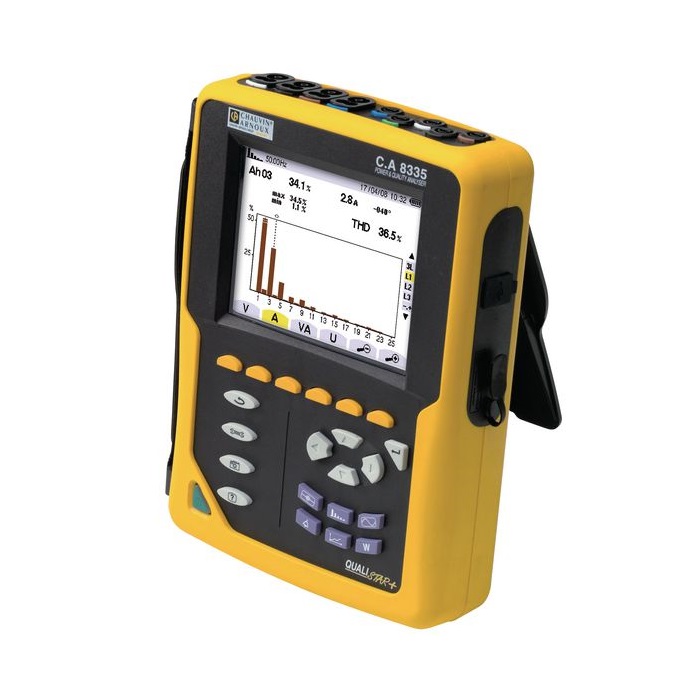
The experiments are carried out using transformers on training panels in panel frames.
Objectives
-
Protective measures and electrical safety
-
Set-up of power generation systems according to circuit diagrams
-
Use of commercial measuring instruments, hand-held multimeters, oscilloscopes, measuring interfaces
Transformers are magnetically coupled systems used for transforming AC voltages or matching impedance. Transformers can therefore be used primarily for measurement or generation of electric power. These practical exercises study exclusively transformers used in energy generation. Transformer power ratings can range from a few mVA up to several MVA. The size and design also have an important effect on the transformer ratings. Transformers are regarded as electrical machines even though they contain no moving parts. The windings of three-phase transformers can be connected in a variety of circuit configurations.
This individual equipment set is used to investigate AC transformers. The AC transformer (single-phase transformer) is a standard module which can be used for many applications across the whole of electrical engineering.
Students carry out the experiments as specified in the printed manual. Hand-held multimeters are used to measure the characteristics of the transformers. The graphical representation of the time course of the current and voltage is not essential. Thus multimeters are sufficient for measuring RMS values.
The target group is made up of commercial apprentices and students of power engineering. The course offers experiments at an intermediate level for vocational colleges and undergraduate level.
The equipment set utilises the 0.3 kW single-phase transformer and for economic reasons, it employs the 1.0 kW resistive load.
Topics
-
Voltage equation and equivalent circuit
-
Measurement without load, with load and with a short circuit
-
Determination of self-inductance, magnetic coupling and leakage
-
Losses, changes in voltage and efficiency
Similar to illustration