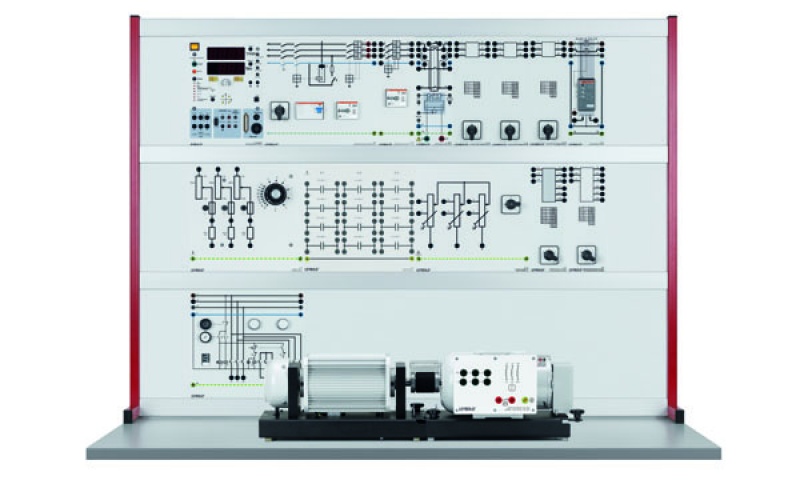
The experiments are carried out using industrial-design machines. All the test machines possess a special base for connecting the Machine test system 1.0. The testing system can be used to record the characteristics of the machines under test. Power for the machines is supplied either via the mains or by special laboratory power supplies.
Objectives
-
Protective measures and electrical safety
-
Setting up electrical machines and putting them into operation
-
Use of starting circuits
-
Assessment of electrical machine characteristics
Squirrel cage rotor D is a special design for asynchronous machines (Dahlander motors). In Dahlander circuits, the three-phase windings of the stator are equipped with a central tap. This allows the number of pole pairs and therefore the speed of the rotor to be switched in the ratio of 1:2.
Features
-
In order to protect against overheating, the stator windings of the machines to be tested are equipped with temperature sensors
-
Should overheating occur, the machine test system automatically shuts down the test machine, thus preventing any damage to it.
-
The machines to be tested are equipped with an educationally designed terminal board with the winding configuration printed on it.
-
The ends of all the windings are connected to the terminal board and can be accessed via 4-mm safety sockets
-
Computer-supported acquisition of measurement data provides for meaningful measurement results.
-
Machines in the 1 kW rating class have a powerful and realistic operating response
-
In comparison to smaller machines, their characteristics display distinctive features related to the design.
The individual equipment set is equally suitable for student experiments in laboratories with low voltage supplies (400 V three-phase) and for setting up on a mobile trolley for demonstration by teachers in a classroom. The procedures for the experiments are provided in a printed manual.
The target group is made up of commercial apprentices and students of electrical machine construction. The course offers experiments at an intermediate level and also allows for the necessary insight into machine behaviour for scientific interpretation at undergraduate level.
Topics
-
Operation of a Dahlander motor at low speed and high speed
-
Connection and operation of a Dahlander motor with the help of a pole change-over switch
-
Recording of characteristics at low speed and high speed
Similar to illustration